
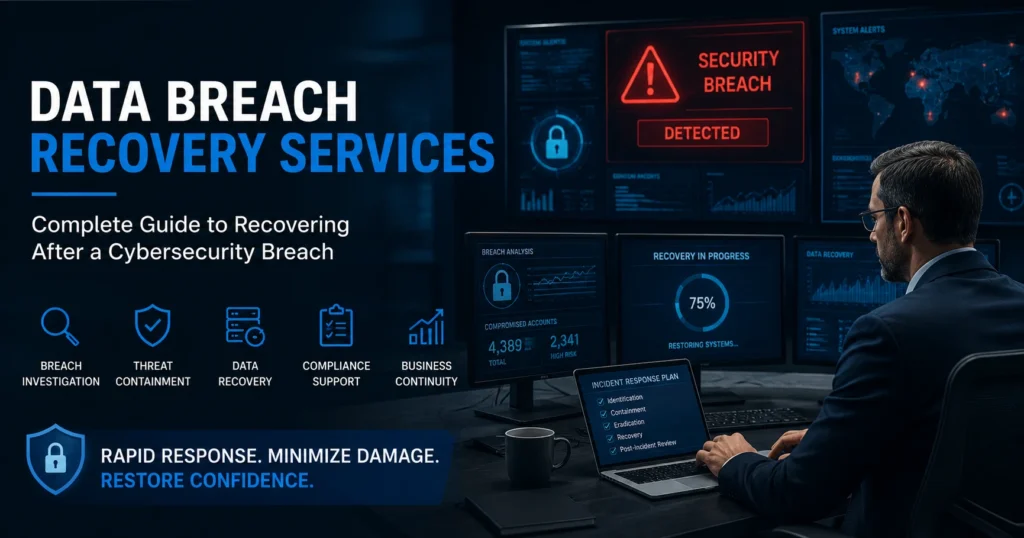
Introduction
Data breaches have become one of the most significant cybersecurity threats facing businesses today. Organizations of all sizes are vulnerable to cyberattacks that expose sensitive information, disrupt operations, damage reputations, and create substantial financial losses. Whether caused by ransomware attacks, insider threats, phishing scams, malware infections, cloud misconfigurations, or stolen credentials, a data breach can have devastating consequences.
The average cost of a data breach continues to rise each year, affecting businesses across industries including healthcare, finance, retail, manufacturing, education, and government sectors. Beyond financial losses, organizations often face legal penalties, regulatory investigations, customer distrust, operational downtime, and long-term reputational damage.
This is where Data Breach Recovery Services become essential. Recovery services help organizations identify the source of the breach, contain the threat, recover compromised systems, restore business operations, protect sensitive information, and strengthen defenses against future attacks.
A successful recovery strategy focuses not only on repairing damage but also on understanding how the breach occurred and implementing security improvements to prevent recurrence.
This comprehensive guide explains Data Breach Recovery Services, their importance, recovery processes, common breach causes, recovery strategies, compliance considerations, and best practices for protecting organizations after a cyber incident.
What Are Data Breach Recovery Services?
Data Breach Recovery Services are specialized cybersecurity services designed to help organizations respond to, investigate, contain, and recover from security breaches involving unauthorized access to sensitive information.
These services typically include:
- Incident response
- Digital forensics
- Threat containment
- Malware removal
- Data restoration
- Compliance support
- Security assessments
- Business continuity planning
The primary objective is to minimize damage, restore normal operations, protect affected individuals, and reduce future cybersecurity risks.
Understanding Data Breaches
A data breach occurs when unauthorized individuals gain access to confidential, sensitive, or protected information.
Examples include:
- Customer records
- Financial data
- Employee information
- Healthcare records
- Intellectual property
- Login credentials
- Business documents
- Proprietary information
Breaches may occur intentionally through cyberattacks or unintentionally through human error and system misconfigurations.
Why Data Breach Recovery Is Important
A data breach can impact every aspect of an organization.
Financial Losses
Organizations often incur costs related to:
- Investigation
- Recovery
- Legal services
- Customer notification
- Regulatory penalties
Reputational Damage
Customers may lose confidence in organizations that fail to protect sensitive information.
Operational Disruption
Breaches can interrupt normal business operations and productivity.
Regulatory Consequences
Failure to protect data can result in compliance violations and fines.
Long-Term Security Risks
Without proper recovery, attackers may retain access to systems.
Common Causes of Data Breaches
Phishing Attacks
Phishing remains one of the most common causes of breaches.
Attackers trick users into revealing credentials or downloading malicious files.
Weak Passwords
Poor password practices make it easier for attackers to gain unauthorized access.
Ransomware
Ransomware attacks frequently involve data theft before encryption occurs.
Insider Threats
Employees, contractors, or third parties may intentionally or accidentally expose sensitive information.
Software Vulnerabilities
Unpatched systems often provide opportunities for attackers.
Cloud Misconfigurations
Incorrect cloud settings can expose sensitive information to the public internet.
Malware Infections
Malware can steal credentials, capture sensitive data, and create unauthorized access points.
Third-Party Vendor Risks
Business partners and vendors can become attack vectors.
Signs of a Data Breach
Organizations should monitor for warning signs such as:
- Unusual account activity
- Unauthorized logins
- Missing files
- Unexpected password changes
- Suspicious network traffic
- Ransom notes
- Unauthorized software installations
- Customer reports of fraud
- Unexpected system behavior
Early detection significantly improves recovery outcomes.
The Data Breach Recovery Process
Effective recovery follows a structured approach.
Step 1: Incident Identification
The first step involves confirming that a breach has occurred.
Security teams gather evidence and assess the scope of the incident.
Step 2: Containment
Containment prevents further damage.
Actions may include:
- Isolating affected systems
- Disabling compromised accounts
- Blocking malicious IP addresses
- Disconnecting infected devices
Step 3: Investigation
Digital forensic specialists analyze:
- System logs
- Network activity
- User behavior
- Malware samples
The goal is to determine:
- How attackers gained access
- What systems were affected
- What data was exposed
Step 4: Eradication
Threats must be completely removed from the environment.
This may involve:
- Malware removal
- Vulnerability remediation
- Account cleanup
- Security patch deployment
Step 5: Recovery
Affected systems and data are restored.
Organizations verify that systems are secure before returning to normal operations.
Step 6: Post-Incident Review
Security teams analyze lessons learned and improve security controls.
Digital Forensics in Data Breach Recovery
Digital forensics is a critical component of breach recovery.
Forensic experts collect and preserve evidence to understand attack methods and impacts.
Key forensic activities include:
- Log analysis
- Malware investigation
- Timeline reconstruction
- User activity review
- Data access monitoring
Forensic findings support legal, regulatory, and security requirements.
Data Recovery After a Breach
Data recovery focuses on restoring lost, damaged, or encrypted information.
Backup Restoration
Secure backups enable rapid recovery of critical systems.
Database Recovery
Organizations restore affected databases while ensuring integrity.
File Recovery
Deleted or corrupted files may be recovered using specialized tools.
Cloud Data Restoration
Cloud backups often provide additional recovery options.
Ransomware and Data Breach Recovery
Many modern ransomware attacks involve data theft before encryption.
Recovery services help organizations:
- Identify stolen information
- Remove ransomware
- Restore systems
- Secure networks
- Assess extortion risks
Rapid response is essential for minimizing ransomware-related damage.
Incident Response and Breach Recovery
Incident response teams play a crucial role during recovery efforts.
Responsibilities include:
- Threat containment
- Communication management
- Recovery planning
- Stakeholder coordination
- Evidence preservation
Organizations with dedicated incident response plans recover faster than those without established procedures.
Business Continuity During Recovery
Business continuity ensures critical operations continue during and after a breach.
Key components include:
Disaster Recovery Planning
Recovery procedures help restore systems quickly.
Backup Infrastructure
Redundant systems reduce downtime.
Crisis Management
Leadership teams coordinate organizational response efforts.
Communication Plans
Clear communication reduces confusion and uncertainty.
Regulatory Compliance After a Data Breach
Many industries have legal obligations following a breach.
GDPR
Organizations must report certain breaches within required timeframes.
HIPAA
Healthcare organizations must address breaches involving protected health information.
PCI-DSS
Payment card data breaches require specific response procedures.
CCPA
Businesses handling consumer information may have notification obligations.
SOC 2
Organizations may need to demonstrate appropriate incident response measures.
Recovery services help organizations meet compliance requirements and avoid penalties.
Customer Notification and Reputation Management
Data breaches often require communication with affected individuals.
Effective communication should include:
- Nature of the breach
- Data involved
- Actions taken
- Recommended customer precautions
- Contact information
Transparent communication helps rebuild trust.
Cyber Insurance and Data Breach Recovery
Many organizations purchase cyber insurance to reduce financial risks.
Insurance may cover:
- Recovery costs
- Legal expenses
- Notification costs
- Forensic investigations
- Business interruption losses
Recovery teams often work directly with insurance providers.
Industries Most Vulnerable to Data Breaches
Healthcare
Healthcare organizations store highly sensitive patient information.
Financial Services
Banks and financial institutions manage valuable financial data.
Retail
Retailers process payment card information and customer records.
Education
Educational institutions maintain extensive student databases.
Government
Government agencies manage sensitive citizen and national security information.
Manufacturing
Manufacturers increasingly rely on digital systems and intellectual property.
Data Breach Recovery Technologies
Modern recovery services use advanced technologies.
Security Information and Event Management (SIEM)
SIEM solutions centralize security monitoring and analysis.
Endpoint Detection and Response (EDR)
EDR tools provide visibility into endpoint activities.
Threat Intelligence Platforms
Threat intelligence helps identify attacker tactics and indicators of compromise.
Backup and Recovery Platforms
Modern backup systems accelerate recovery efforts.
Cloud Security Solutions
Cloud-native security tools support recovery in cloud environments.
Challenges During Data Breach Recovery
Identifying the Full Scope
Determining exactly what data was compromised can be difficult.
Advanced Threat Persistence
Attackers often maintain hidden access methods.
Regulatory Complexity
Organizations must navigate multiple compliance requirements.
Business Downtime
Extended outages can create significant financial losses.
Public Relations Impact
Negative publicity may affect customer confidence.
Best Practices for Successful Data Breach Recovery
Develop an Incident Response Plan
Organizations should prepare for breaches before they occur.
Conduct Regular Security Assessments
Routine assessments identify vulnerabilities.
Maintain Secure Backups
Backups should be tested regularly.
Implement Multi-Factor Authentication
MFA reduces unauthorized access risks.
Train Employees
Security awareness training reduces phishing success rates.
Monitor Systems Continuously
Continuous monitoring improves threat detection.
Test Recovery Procedures
Recovery plans should be validated through simulations and exercises.
The Cost of Data Breaches
Data breaches create numerous expenses.
Examples include:
- Incident response
- Forensics
- Recovery services
- Regulatory fines
- Legal fees
- Lost revenue
- Customer compensation
- Security improvements
Investing in recovery preparedness often costs significantly less than responding to a major breach without a plan.
Future Trends in Data Breach Recovery
AI-Powered Incident Response
Artificial intelligence improves detection and recovery speed.
Automated Recovery Workflows
Automation reduces response times and human error.
Cloud-Based Recovery Solutions
Cloud technologies enhance resilience and scalability.
Zero Trust Security Models
Zero Trust frameworks reduce breach impacts.
Continuous Threat Monitoring
Organizations increasingly adopt proactive monitoring strategies.
Frequently Asked Questions
What is a data breach?
A data breach occurs when unauthorized individuals gain access to confidential or sensitive information.
How long does data breach recovery take?
Recovery time depends on the severity of the breach, affected systems, and available recovery resources.
Can deleted data be recovered after a breach?
In many cases, deleted or corrupted data can be restored from backups or recovered using specialized tools.
What should organizations do immediately after a breach?
Organizations should contain the incident, preserve evidence, begin investigation efforts, and engage cybersecurity professionals.
Are Data Breach Recovery Services necessary for small businesses?
Yes. Small businesses are frequently targeted by cybercriminals and often require professional recovery assistance.
Conclusion
Data breaches have become an unfortunate reality for organizations operating in today’s digital landscape. Cybercriminals continue developing sophisticated attack methods that target businesses of all sizes and industries. The consequences of a successful breach can include financial losses, operational disruption, regulatory penalties, reputational damage, and loss of customer trust.
Data Breach Recovery Services provide organizations with the expertise, tools, and processes needed to recover effectively from cybersecurity incidents. Through rapid incident response, digital forensics, threat containment, data restoration, compliance support, and security improvements, recovery specialists help minimize damage and restore business operations as quickly as possible.
Organizations that invest in recovery planning, continuous monitoring, employee training, and modern cybersecurity defenses are better prepared to respond to breaches and reduce long-term impacts. As cyber threats continue evolving, Data Breach Recovery Services remain an essential component of every organization’s cybersecurity and business continuity strategy.