
Introduction
Cyber threats continue to evolve at an alarming pace. Businesses of every size face constant attacks from ransomware groups, hackers, insider threats, malware campaigns, phishing attacks, credential theft, advanced persistent threats (APTs), and sophisticated cybercriminal organizations. Traditional security tools alone are no longer enough to protect modern IT environments.
Organizations now operate across cloud platforms, remote work environments, mobile devices, SaaS applications, and hybrid infrastructures. This expanded digital landscape creates more opportunities for attackers to exploit vulnerabilities and gain unauthorized access to sensitive systems and data.
As cybersecurity threats become more complex, businesses require continuous monitoring and rapid threat response capabilities. This is where SOC Monitoring Services play a critical role.
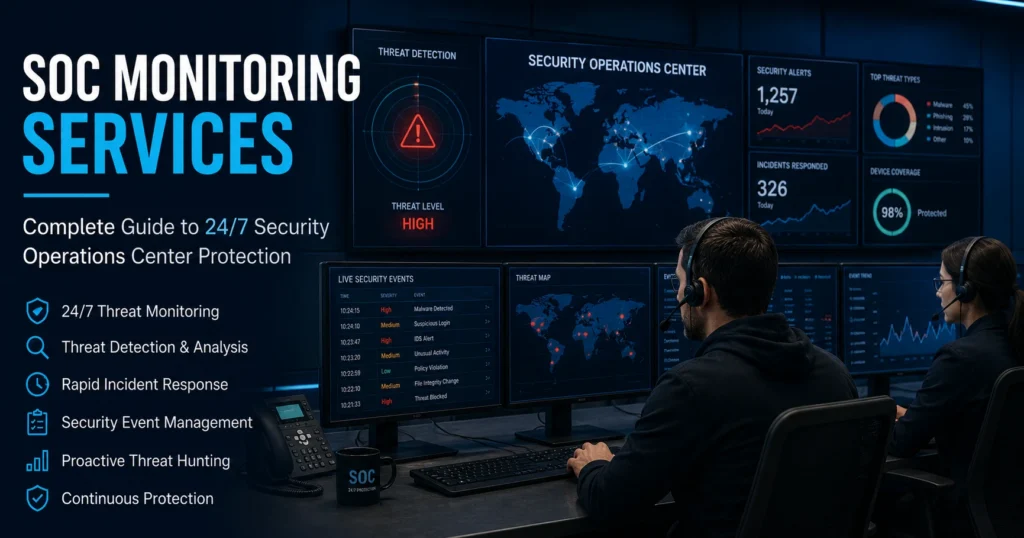
A Security Operations Center (SOC) serves as the central hub for cybersecurity monitoring, threat detection, incident response, security analysis, and continuous risk management. SOC Monitoring Services provide organizations with around-the-clock visibility into their IT environment, helping security teams identify and respond to threats before significant damage occurs.
This comprehensive guide explains SOC Monitoring Services, how they work, their benefits, technologies, components, best practices, and why modern organizations rely on 24/7 security monitoring to strengthen their cybersecurity posture.
What Are SOC Monitoring Services?
SOC Monitoring Services are cybersecurity services that provide continuous monitoring, detection, investigation, and response to security threats across an organization’s infrastructure.
A Security Operations Center combines:
- Security analysts
- Threat intelligence
- Monitoring tools
- Incident response capabilities
- Security technologies
The primary objective is to detect malicious activity quickly and minimize the impact of cybersecurity incidents.
SOC Monitoring Services typically include:
- 24/7 security monitoring
- Threat detection
- Incident investigation
- Security alert management
- Vulnerability monitoring
- Security reporting
- Threat hunting
- Compliance monitoring
- Malware analysis
- Incident response coordination
Understanding the Security Operations Center (SOC)
A Security Operations Center is a dedicated team and infrastructure responsible for monitoring and protecting an organization’s digital assets.
SOC teams continuously monitor:
- Networks
- Endpoints
- Servers
- Cloud environments
- Applications
- User activities
- Security devices
The SOC acts as the organization’s cybersecurity command center.
Why SOC Monitoring Services Are Important
Cyberattacks occur every day.
Many organizations experience:
- Phishing attacks
- Ransomware infections
- Insider threats
- Credential theft
- Data breaches
- Malware outbreaks
Without continuous monitoring, threats may remain undetected for weeks or months.
SOC Monitoring Services help organizations:
Detect Threats Early
Early detection reduces damage and recovery costs.
Improve Incident Response
SOC teams investigate and respond to threats quickly.
Reduce Security Risks
Continuous monitoring helps identify vulnerabilities and suspicious behavior.
Support Compliance Requirements
Many regulations require ongoing security monitoring.
Minimize Business Disruption
Fast response limits operational downtime.
Core Functions of SOC Monitoring Services
Security Event Monitoring
SOC teams collect and analyze security events from multiple sources.
Examples include:
- Firewalls
- Servers
- Endpoints
- Cloud platforms
- Applications
- Identity systems
Threat Detection
Advanced tools identify suspicious activities and potential attacks.
Incident Investigation
Security analysts investigate alerts to determine whether a threat exists.
Threat Response
SOC teams coordinate containment and remediation efforts.
Threat Intelligence Integration
Threat intelligence improves detection accuracy and awareness.
Security Reporting
Organizations receive detailed reports regarding security events and trends.
How SOC Monitoring Services Work
SOC monitoring follows a structured process.
Data Collection
Security data is gathered from various systems.
Sources may include:
- Firewalls
- SIEM platforms
- Endpoint security tools
- Cloud environments
- Authentication systems
- Network devices
Event Correlation
Security tools correlate events from multiple sources.
Patterns that indicate malicious activity are identified.
Alert Generation
Potential threats generate alerts for analyst review.
Threat Investigation
Security analysts validate alerts and determine threat severity.
Incident Response
Confirmed threats trigger response procedures.
Continuous Improvement
SOC teams refine detection rules and security controls over time.
Components of SOC Monitoring Services
Security Information and Event Management (SIEM)
SIEM platforms collect and analyze security logs.
Common SIEM capabilities include:
- Log aggregation
- Event correlation
- Alert generation
- Threat detection
- Reporting
Endpoint Detection and Response (EDR)
EDR solutions monitor endpoints for suspicious activity.
Benefits include:
- Malware detection
- Behavioral analysis
- Threat containment
- Endpoint visibility
Security Orchestration, Automation, and Response (SOAR)
SOAR platforms automate security workflows.
Automation helps:
- Reduce response times
- Improve consistency
- Eliminate repetitive tasks
Threat Intelligence Platforms
Threat intelligence provides information about emerging threats.
SOC teams use intelligence to identify:
- Malicious IP addresses
- Attack techniques
- Threat actors
- Indicators of compromise
Network Monitoring Tools
Network monitoring helps identify suspicious traffic patterns.
24/7 Security Monitoring
One of the most valuable aspects of SOC Monitoring Services is continuous monitoring.
Cybercriminals operate around the clock.
Threats can emerge:
- During weekends
- Overnight
- On holidays
- Outside business hours
24/7 monitoring ensures immediate visibility into potential attacks.
Threat Detection Capabilities
SOC Monitoring Services identify various cybersecurity threats.
Malware Detection
Detects malicious software activity.
Ransomware Detection
Identifies encryption attempts and suspicious file activity.
Insider Threat Detection
Monitors unusual user behavior.
Credential Theft Detection
Identifies compromised account activity.
Data Exfiltration Detection
Detects unauthorized data transfers.
Advanced Persistent Threat Detection
Identifies sophisticated long-term attacks.
Phishing Attack Detection
Recognizes indicators of phishing campaigns.
Security Incident Response
SOC teams support incident response activities.
Response actions may include:
- Alert validation
- Threat containment
- Malware removal
- Account lockdown
- System isolation
- Evidence preservation
Fast response reduces attack impact.
Threat Hunting Services
Threat hunting proactively searches for hidden threats.
Unlike traditional monitoring, threat hunting focuses on:
- Unknown threats
- Advanced attackers
- Suspicious behavior
- Emerging attack patterns
Threat hunters actively investigate systems for signs of compromise.
SOC Monitoring for Cloud Security
Modern organizations increasingly rely on cloud services.
SOC Monitoring Services provide visibility into:
- Microsoft 365
- Azure
- AWS
- Google Cloud
- SaaS applications
Cloud monitoring helps detect:
- Unauthorized access
- Misconfigurations
- Data exposure
- Suspicious activity
SOC Monitoring for Endpoint Security
Endpoints remain primary targets for attackers.
SOC services monitor:
- Workstations
- Laptops
- Mobile devices
- Servers
Endpoint monitoring helps identify threats before they spread.
SOC Monitoring and Compliance
Many regulations require continuous security monitoring.
HIPAA
Healthcare organizations must protect patient data.
PCI-DSS
Organizations handling payment information require monitoring controls.
GDPR
Continuous monitoring supports data protection requirements.
SOC 2
Monitoring is essential for maintaining security controls.
ISO 27001
Security monitoring supports compliance initiatives.
SOC services help organizations meet regulatory obligations.
Benefits of SOC Monitoring Services
Continuous Protection
Organizations receive around-the-clock security coverage.
Faster Threat Detection
Threats are identified quickly.
Reduced Risk
Continuous monitoring minimizes attack impact.
Improved Visibility
Organizations gain deeper insight into security events.
Access to Security Experts
SOC services provide experienced cybersecurity professionals.
Cost Efficiency
Outsourced SOC services often cost less than building internal teams.
Better Incident Response
Response capabilities improve significantly.
Challenges Addressed by SOC Monitoring Services
Alert Fatigue
SOC teams filter and prioritize alerts.
Talent Shortages
Organizations gain access to cybersecurity expertise.
Complex Threats
Advanced tools improve threat detection.
Limited Visibility
Monitoring provides comprehensive security insights.
Growing Attack Surfaces
SOC services help secure hybrid environments.
Industries That Benefit from SOC Monitoring
Healthcare
Protects sensitive patient information.
Financial Services
Monitors financial transactions and critical systems.
Government
Secures sensitive public sector infrastructure.
Manufacturing
Protects operational technology and intellectual property.
Retail
Safeguards customer information and payment systems.
Education
Protects student records and institutional systems.
SOC Monitoring vs Traditional Security Monitoring
Traditional monitoring often focuses on individual tools.
SOC Monitoring Services provide:
- Centralized visibility
- Threat intelligence
- Security expertise
- Incident response
- Continuous analysis
SOC monitoring delivers a more comprehensive cybersecurity approach.
Managed SOC Services
Managed SOC services allow organizations to outsource security monitoring.
Benefits include:
- Lower operational costs
- 24/7 coverage
- Access to experts
- Faster deployment
- Scalability
Many businesses choose managed SOC services due to resource constraints.
Building an Effective SOC Strategy
Define Security Objectives
Organizations should identify key security priorities.
Implement SIEM Solutions
Centralized log management improves visibility.
Establish Incident Response Plans
Preparedness accelerates recovery.
Integrate Threat Intelligence
Threat intelligence enhances detection capabilities.
Conduct Continuous Training
Security teams should remain current with emerging threats.
Regularly Review Security Controls
Ongoing improvement strengthens defenses.
Emerging Trends in SOC Monitoring Services
Artificial Intelligence
AI improves threat detection and analysis.
Machine Learning
Machine learning helps identify abnormal behavior.
Extended Detection and Response (XDR)
XDR expands visibility across security layers.
Security Automation
Automation reduces response times.
Cloud-Native Security Monitoring
Cloud-focused monitoring continues to grow.
Zero Trust Integration
Zero Trust security enhances threat prevention.
Common SOC Monitoring Metrics
Organizations measure SOC effectiveness using:
- Mean Time to Detect (MTTD)
- Mean Time to Respond (MTTR)
- Incident volume
- False positive rates
- Threat containment times
- Vulnerability remediation rates
These metrics support continuous improvement.
Frequently Asked Questions
What is a SOC Monitoring Service?
SOC Monitoring Services provide continuous cybersecurity monitoring, threat detection, incident response, and security analysis.
Why does my business need SOC monitoring?
Cyber threats occur constantly, and SOC monitoring helps detect and respond to attacks before significant damage occurs.
Is SOC monitoring available 24/7?
Yes. Most SOC Monitoring Services operate around the clock to provide continuous protection.
What threats can SOC monitoring detect?
SOC services detect ransomware, malware, phishing attacks, insider threats, credential theft, data breaches, and advanced cyberattacks.
Can small businesses benefit from SOC Monitoring Services?
Absolutely. Small and medium-sized businesses are frequently targeted by cybercriminals and can benefit significantly from professional monitoring.
Conclusion
Cybersecurity threats continue to increase in frequency, sophistication, and impact. Organizations can no longer rely solely on traditional security tools to defend against ransomware, malware, phishing attacks, insider threats, credential theft, and advanced persistent threats. Continuous visibility and rapid response have become essential components of modern cybersecurity programs.
SOC Monitoring Services provide organizations with 24/7 security monitoring, threat detection, incident response, threat hunting, compliance support, and expert cybersecurity oversight. By combining advanced security technologies, skilled analysts, threat intelligence, and automated response capabilities, Security Operations Centers help organizations identify threats quickly and minimize business risk.
Whether protecting cloud environments, on-premises infrastructure, endpoints, applications, or hybrid networks, SOC Monitoring Services offer the proactive security approach needed to combat today’s evolving cyber threats. Organizations that invest in continuous monitoring, rapid response, and strategic security operations are significantly better positioned to prevent breaches, maintain compliance, protect sensitive information, and ensure long-term business resilience.