
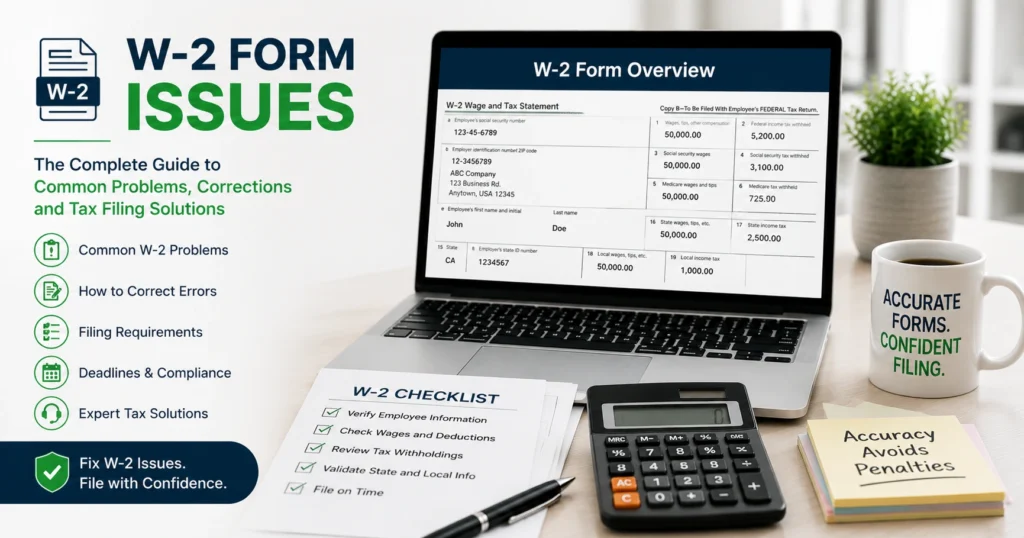
Tax season can be stressful, especially when problems arise with important tax documents. Among the most common tax-related concerns faced by employees is dealing with W-2 form issues. Whether it’s a missing W-2, incorrect information, reporting errors, or delayed delivery, these problems can create confusion and potentially delay tax filing.
A W-2 form is one of the most important documents employees receive each year because it reports wages earned and taxes withheld during the tax year. Any inaccuracies on this form can impact tax returns, refunds, and overall compliance with tax regulations. Understanding how to identify, address, and prevent W-2 form issues is essential for both employees and employers.
This comprehensive guide covers everything you need to know about W-2 form issues, including common errors, correction procedures, filing implications, employer responsibilities, and best practices for ensuring accurate tax reporting.
Understanding the W-2 Form
The W-2 form is an annual wage and tax statement provided by employers to employees. It summarizes income earned during the year and details various tax withholdings.
The information reported on a W-2 typically includes:
Employee name and address
Employer information
Social Security number
Federal taxable wages
State taxable wages
Federal income tax withheld
State income tax withheld
Social Security taxes withheld
Medicare taxes withheld
Retirement plan contributions
Additional compensation information
Employees use this information when preparing and filing tax returns. Because tax authorities also receive copies of W-2 forms, accuracy is critical.
Why W-2 Form Issues Matter
Many taxpayers underestimate the importance of reviewing their W-2 carefully. Even a small error can cause complications during tax season.
Common consequences of W-2 form issues include:
Delayed tax refunds
Incorrect tax calculations
Tax notices from authorities
Additional paperwork
Potential penalties
Identity verification problems
Increased audit risk
Addressing errors quickly can help prevent larger problems later.
Common W-2 Form Issues Employees Face
Several issues occur frequently during tax season.
Missing W-2 Forms
One of the most common concerns is not receiving a W-2 by the expected deadline.
This can happen due to:
Incorrect mailing addresses
Employer processing delays
Lost mail
Administrative errors
Business closures
Employees should contact their employer immediately if a W-2 has not been received.
Incorrect Personal Information
Errors involving personal information are surprisingly common.
These may include:
Misspelled names
Incorrect addresses
Wrong Social Security numbers
Outdated employee information
Even minor mistakes can create matching issues during tax return processing.
Incorrect Wage Reporting
Sometimes wages reported on the W-2 do not match actual earnings.
Possible causes include:
Payroll processing errors
Incorrect overtime calculations
Bonus reporting mistakes
Missing compensation records
Employees should compare W-2 amounts with final pay statements to identify discrepancies.
Tax Withholding Errors
Incorrect withholding information can significantly affect tax obligations.
Issues may include:
Overreported withholding
Underreported withholding
Missing tax payments
Incorrect state tax information
These mistakes can impact refunds and tax balances due.
Duplicate W-2 Forms
Some employees receive multiple forms from the same employer unexpectedly.
This situation may occur due to:
Payroll system changes
Corporate restructuring
Reporting corrections
Administrative duplication
Understanding why multiple forms were issued is essential before filing a return.
Employer Responsibilities Regarding W-2 Forms
Employers play a critical role in accurate W-2 reporting.
Key responsibilities include:
Maintaining payroll records
Calculating employee earnings accurately
Reporting tax withholdings correctly
Distributing forms on time
Submitting forms to tax authorities
Correcting identified errors promptly
Failure to meet these obligations may result in penalties and compliance issues.
What to Do If Your W-2 Is Missing
If a W-2 has not arrived, employees should take immediate action.
First, verify that the employer has the correct mailing address.
Next, contact the payroll or human resources department to request a copy.
Many employers provide electronic access through employee portals.
If employer contact attempts are unsuccessful, taxpayers should gather alternative documentation such as final pay stubs and payroll records.
Early action can help avoid filing delays.
How to Identify W-2 Errors
Reviewing a W-2 carefully before filing taxes is essential.
Employees should verify:
Name spelling
Social Security number accuracy
Employer information
Wage totals
Tax withholding amounts
Retirement contributions
State tax information
Comparing the form against payroll records helps identify discrepancies quickly.
Understanding Form W-2c Corrections
When a W-2 contains errors, employers typically issue a corrected form known as a W-2c.
A W-2c updates previously reported information and ensures accurate tax reporting.
Common reasons for issuing a W-2c include:
Incorrect wages
Tax withholding errors
Employee information corrections
Benefit reporting adjustments
Retirement contribution updates
Employees should wait for corrected forms before filing whenever possible.
Filing Taxes with an Incorrect W-2
Filing with incorrect information can create complications.
Potential consequences include:
Refund delays
Processing issues
Tax notices
Amended return requirements
Additional documentation requests
Whenever possible, taxpayers should obtain corrected information before filing.
If immediate filing is necessary, professional tax guidance may help determine the best approach.
How W-2 Errors Affect Tax Refunds
Refund calculations depend heavily on W-2 information.
Incorrect wage reporting may:
Increase taxable income
Reduce deductions
Change tax brackets
Impact eligibility for credits
Alter refund amounts
Likewise, withholding errors can result in unexpectedly large balances due or smaller refunds than anticipated.
State Tax Issues on W-2 Forms
Employees working in multiple states often encounter additional reporting complexities.
Common issues include:
Incorrect state allocations
Missing state wages
Wrong withholding amounts
Multiple state reporting errors
Remote work arrangements have increased the importance of accurate state tax reporting in recent years.
Careful review is especially important for employees who worked in more than one location.
W-2 Issues for Remote Employees
The rise of remote work has introduced new tax challenges.
Employees may encounter:
State reporting confusion
Local tax discrepancies
Address-related errors
Jurisdictional withholding problems
Employers and employees should communicate clearly regarding work locations and tax obligations.
Identity Theft and W-2 Problems
Tax-related identity theft remains a concern.
Warning signs may include:
Unexpected W-2 forms
Unknown employer information
Incorrect earnings records
Duplicate tax filings
Suspicious tax notices
Prompt action is necessary when identity theft is suspected.
Employees should monitor tax records carefully and report unusual activity immediately.
Best Practices for Employees
Preventing W-2 issues begins with proactive recordkeeping.
Recommended practices include:
Review pay stubs regularly
Update personal information promptly
Retain payroll records
Verify withholding elections annually
Monitor tax documents closely
Maintain copies of previous tax returns
These habits help identify discrepancies before they become major problems.
Best Practices for Employers
Employers can reduce W-2 issues through strong payroll management practices.
Key recommendations include:
Maintain accurate employee records
Conduct payroll audits
Use reliable payroll software
Verify Social Security information
Review tax calculations regularly
Issue forms promptly
Respond quickly to correction requests
Strong internal controls improve compliance and reduce reporting errors.
Technology’s Role in Reducing W-2 Errors
Modern payroll systems have significantly improved reporting accuracy.
Benefits include:
Automated calculations
Electronic filing
Employee self-service portals
Real-time payroll monitoring
Data validation tools
Integrated tax reporting
Technology reduces manual entry errors and streamlines year-end reporting.
Frequently Asked Questions About W-2 Form Issues
Can I file taxes without a W-2?
In some situations, alternative documentation may be used, but obtaining the official form is generally preferred.
What should I do if my name is spelled incorrectly?
Contact your employer immediately and request a correction.
How long does it take to receive a corrected W-2?
Processing times vary depending on the employer and the nature of the correction.
Will a corrected W-2 affect my refund?
Potentially. Any change to wages or withholding amounts may impact tax calculations.
Can employers be penalized for W-2 errors?
Yes. Significant reporting failures may result in penalties and compliance issues.
The Future of W-2 Reporting
Payroll reporting continues to evolve through automation and digital transformation.
Emerging trends include:
Electronic document delivery
Cloud-based payroll management
Enhanced data verification
Artificial intelligence applications
Improved compliance monitoring
These advancements are expected to reduce reporting errors and improve taxpayer experiences.
Conclusion
W-2 Form Issues can create unnecessary stress during tax season, but understanding the most common problems and their solutions can make the process much easier. From missing forms and incorrect wages to withholding discrepancies and personal information errors, addressing issues quickly is essential for accurate tax filing and compliance.
Both employees and employers share responsibility for maintaining accurate records and ensuring proper reporting. By reviewing tax documents carefully, utilizing modern payroll technology, and seeking assistance when necessary, taxpayers can minimize errors and avoid costly complications.
A proactive approach to W-2 management not only simplifies tax season but also helps ensure accurate reporting, timely refunds, and greater financial confidence year after year.