
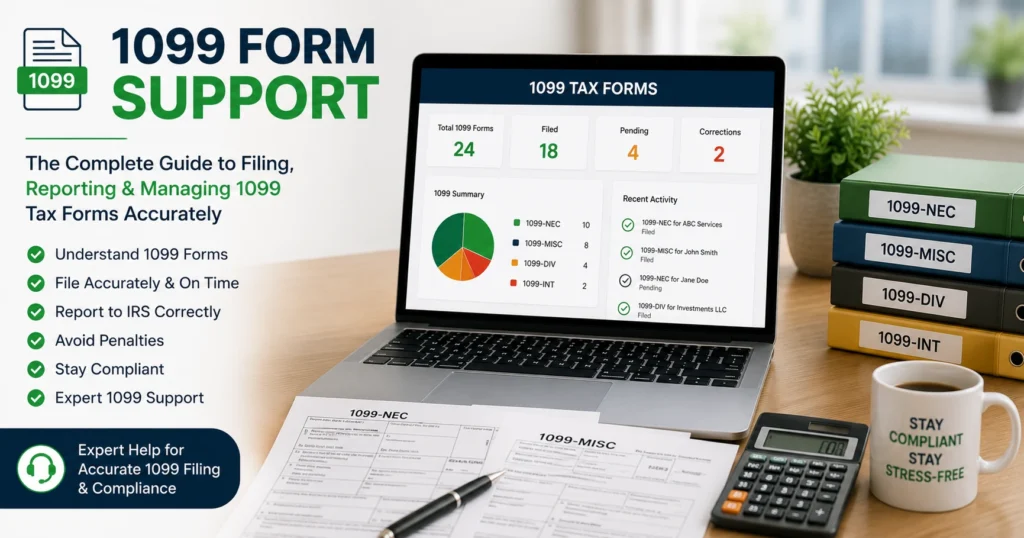
If you’re a freelancer, independent contractor, small business owner, or self-employed professional, understanding 1099 forms is essential for tax compliance. Every year, millions of taxpayers receive or issue 1099 forms to report various types of income outside traditional employment. However, many individuals and businesses struggle with filing requirements, reporting obligations, deadlines, and compliance rules. This is where 1099 Form Support becomes invaluable.
Whether you’re issuing forms to contractors, receiving multiple 1099s from clients, or simply trying to understand your tax obligations, having access to proper 1099 form support can save time, reduce errors, and help avoid penalties. In this comprehensive guide, we’ll cover everything you need to know about 1099 forms, including who needs them, how they work, filing deadlines, common mistakes, and best practices for accurate reporting.
What Is a 1099 Form?
A 1099 form is an information return used to report income received outside of regular wages or salaries. Unlike employees who receive a W-2 form from their employer, independent contractors, freelancers, consultants, investors, and other non-employees often receive one or more 1099 forms to report income earned during the tax year.
The purpose of a 1099 form is to inform tax authorities about payments made to individuals or businesses. This helps ensure that income is accurately reported and taxes are paid accordingly.
There are several types of 1099 forms used for different purposes. Each serves a specific reporting function and has unique filing requirements.
Why 1099 Form Support Matters
Many taxpayers underestimate the complexity of 1099 reporting. Incorrect information, missed deadlines, or filing errors can lead to costly penalties and compliance issues.
Professional 1099 form support helps businesses and individuals:
Understand reporting requirements
Meet filing deadlines
Avoid penalties and interest
Maintain accurate records
Correct filing mistakes
Manage contractor payments
Improve tax compliance
Whether you’re filing one form or hundreds, proper guidance can simplify the process significantly.
Common Types of 1099 Forms
Understanding the various types of 1099 forms is essential for accurate reporting.
1099-NEC
The 1099-NEC is used to report nonemployee compensation. Businesses typically issue this form to independent contractors who receive compensation above applicable reporting thresholds during the year.
Freelancers, consultants, designers, writers, marketers, and other self-employed professionals commonly receive this form.
1099-MISC
The 1099-MISC reports miscellaneous income such as rent payments, prizes, awards, and certain other types of compensation.
Although many contractor payments have moved to Form 1099-NEC, Form 1099-MISC remains an important reporting document.
1099-INT
This form reports interest income earned through banks, credit unions, and financial institutions.
Taxpayers earning interest from savings accounts or investments often receive this form annually.
1099-DIV
The 1099-DIV reports dividend income and distributions from investments.
Investors commonly receive this form from brokerage firms and investment companies.
1099-K
The 1099-K reports payment transactions processed through third-party payment networks and online marketplaces.
With the growth of eCommerce and gig economy platforms, this form has become increasingly common.
1099-R
This form reports distributions from retirement accounts, pensions, annuities, and similar financial products.
Individuals taking retirement withdrawals often receive a 1099-R.
Who Needs 1099 Form Support?
1099 reporting affects a wide range of taxpayers.
Freelancers often need help understanding how multiple 1099 forms impact their tax obligations.
Small business owners require support when issuing forms to contractors and service providers.
Self-employed professionals may need assistance reconciling income from various clients.
Online sellers frequently seek guidance regarding marketplace and payment processor reporting.
Investors often require help interpreting dividend and interest reporting forms.
Organizations issuing numerous forms benefit from professional filing solutions and compliance support.
How Businesses Issue 1099 Forms
Businesses must follow specific procedures when issuing 1099 forms.
The process typically begins with collecting taxpayer information from contractors. This information is generally obtained through a completed tax identification form before work begins.
Businesses should maintain accurate payment records throughout the year. At year-end, payments must be reviewed to determine whether reporting requirements apply.
Once reporting obligations are confirmed, businesses prepare and distribute forms to recipients and file copies with tax authorities.
Accurate recordkeeping is essential throughout the process.
Key Information Included on a 1099 Form
A typical 1099 form contains several important details.
Payer information identifies the business or organization making the payment.
Recipient information identifies the individual or business receiving income.
Taxpayer identification numbers help ensure accurate reporting.
Payment amounts show total compensation or income reported during the tax year.
Additional details may include withholding amounts and other reporting-specific information.
Errors in any of these fields can create complications and may require corrected filings.
Common 1099 Filing Mistakes
Many taxpayers encounter issues due to avoidable errors.
One common mistake is reporting incorrect taxpayer identification numbers.
Another frequent issue involves filing forms after required deadlines.
Businesses sometimes misclassify workers, leading to incorrect reporting forms.
Duplicate reporting can also create confusion and trigger notices from tax authorities.
Failure to maintain supporting documentation may create challenges during audits or compliance reviews.
Proper 1099 form support helps identify and prevent these mistakes before they become costly problems.
Benefits of Professional 1099 Form Support
Professional support provides several advantages.
Experts understand current reporting requirements and filing procedures.
They can verify information before submission to reduce errors.
Professional services often automate large portions of the filing process.
Many providers offer correction services when mistakes occur.
Businesses save time by outsourcing administrative tasks associated with tax reporting.
Most importantly, professional guidance helps reduce compliance risks and potential penalties.
How Technology Simplifies 1099 Reporting
Modern tax software has transformed 1099 management.
Businesses can now track contractor payments throughout the year and generate forms automatically when reporting thresholds are met.
Cloud-based solutions provide secure storage for contractor information and payment records.
Automated filing systems help ensure timely submission.
Digital delivery options simplify recipient access to tax documents.
These technologies improve efficiency while reducing administrative burden.
Best Practices for Managing 1099 Forms
Successful 1099 compliance begins with strong organizational practices.
Collect contractor information before issuing payments.
Maintain accurate records throughout the year.
Review payment data regularly to identify reporting obligations.
Verify taxpayer identification numbers before filing.
Use reliable software solutions whenever possible.
File forms before deadlines to avoid penalties.
Retain records for future reference and audit support.
These practices can significantly improve reporting accuracy and compliance outcomes.
What to Do If You Receive a 1099 Form
Receiving a 1099 form does not necessarily mean additional taxes are owed, but it does indicate that income has been reported.
Taxpayers should carefully review each form for accuracy.
Any discrepancies should be addressed promptly with the issuer.
Income reported on 1099 forms generally must be included on tax returns unless specific exceptions apply.
Maintaining records that support reported income is essential.
Professional tax assistance may be helpful when multiple forms or complex income situations are involved.
The Future of 1099 Reporting
Tax reporting requirements continue to evolve as governments seek greater transparency and compliance.
Digital reporting systems are becoming more common.
Automation is reducing manual filing requirements.
Electronic document delivery continues to expand.
Businesses and individuals who adopt modern reporting solutions will likely benefit from improved efficiency and reduced compliance risks.
As regulations change, staying informed and utilizing reliable 1099 form support will remain essential for accurate tax reporting.
Conclusion
1099 forms play a critical role in reporting nonemployee compensation, investment income, payment transactions, and various other types of taxable income. Whether you’re issuing forms as a business owner or receiving them as a contractor, understanding reporting requirements is essential for maintaining compliance and avoiding costly mistakes.
Professional 1099 Form Support can simplify the filing process, improve accuracy, reduce administrative burdens, and help ensure that all reporting obligations are met. By maintaining organized records, understanding deadlines, leveraging technology, and seeking expert assistance when needed, taxpayers can confidently manage their 1099 responsibilities and achieve greater peace of mind during tax season.