
Introduction
W-2 forms play a critical role in the U.S. tax system. Employers use them to report employee wages, taxes withheld, and other compensation details, while employees rely on them to accurately file their tax returns. Unfortunately, W-2 issues are common and can create confusion, delayed tax refunds, IRS notices, payroll compliance concerns, and filing errors.
Whether you’re an employee waiting for a missing W-2, a business owner dealing with payroll reporting problems, or an accountant troubleshooting tax discrepancies, understanding common W-2 form issues can save significant time and money.
This comprehensive guide covers everything about W-2 Form Issues, including causes, solutions, corrections, filing requirements, payroll compliance, tax reporting challenges, and best practices to ensure accurate reporting.
What Is a W-2 Form?
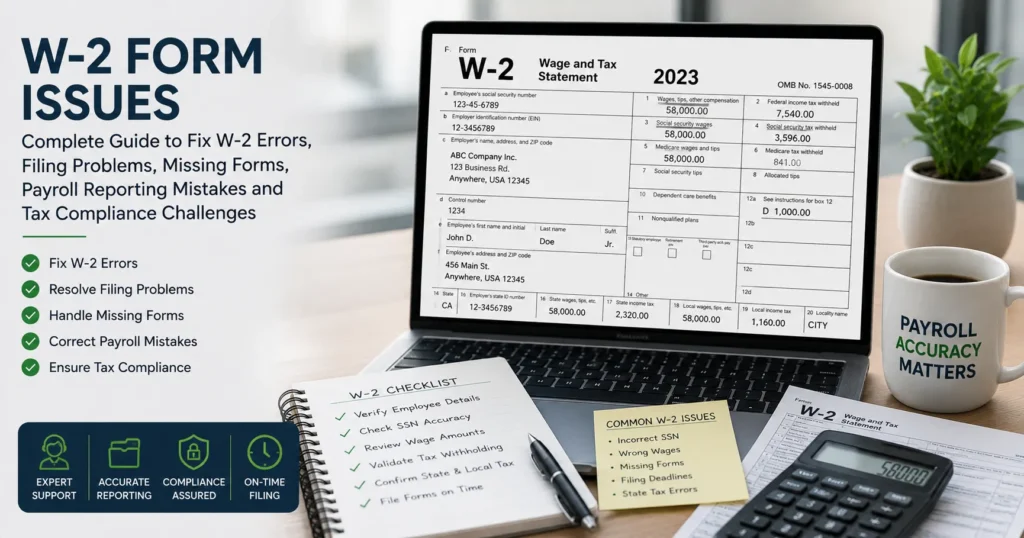
A W-2 form, officially known as the Wage and Tax Statement, is a tax document employers provide to employees annually.
The form reports:
- Total wages earned
- Federal income tax withheld
- State income tax withheld
- Social Security wages
- Medicare wages
- Retirement contributions
- Employee benefits
Employees use this information when filing their federal and state tax returns.
Why W-2 Forms Are Important
W-2 forms serve several important purposes:
Employee Tax Filing
Employees need W-2 forms to accurately file tax returns.
IRS Reporting
The IRS compares tax returns against employer-submitted W-2 information.
Payroll Compliance
Employers must accurately report employee compensation and taxes.
Tax Refund Processing
Errors can delay refunds and trigger audits.
Common W-2 Form Issues
Many businesses and employees encounter W-2 problems every tax season.
Common issues include:
- Missing W-2 forms
- Incorrect employee information
- Wrong Social Security numbers
- Wage reporting errors
- Tax withholding mistakes
- Duplicate W-2 forms
- Incorrect employer details
- State tax reporting errors
- Filing deadline problems
- Payroll software issues
Missing W-2 Forms
One of the most frequent complaints during tax season is not receiving a W-2.
Possible Causes
- Incorrect mailing address
- Employer delays
- Lost mail
- Payroll processing errors
- Former employer communication issues
How to Fix It
Contact the Employer
Request a replacement W-2.
Verify Contact Information
Ensure your address and personal details are current.
Check Online Payroll Portals
Many employers provide electronic W-2 access.
Contact the IRS
If the employer does not respond, the IRS may assist.
Incorrect Employee Name
Even small spelling mistakes can create filing problems.
Examples include:
- Misspelled names
- Missing middle initials
- Name changes not updated
- Hyphenation errors
Solution
Contact the employer immediately and request a corrected W-2.
Wrong Social Security Number
A mismatched Social Security Number (SSN) can result in:
- IRS notices
- Tax return rejections
- Delayed refunds
- Payroll discrepancies
Common Causes
- Data entry mistakes
- Payroll system errors
- Employee onboarding issues
Resolution
Employers must issue a corrected W-2 showing the proper SSN.
Wage Reporting Errors
Incorrect wage reporting is among the most serious W-2 problems.
Examples include:
- Underreported wages
- Overreported wages
- Missing bonuses
- Duplicate income entries
- Omitted compensation
Impact
Employees may:
- Pay too much tax
- Pay too little tax
- Receive IRS notices
- Face audit risks
Federal Tax Withholding Errors
Tax withholding mistakes can significantly affect tax returns.
Common examples include:
- Too much tax withheld
- Too little tax withheld
- Incorrect withholding calculations
- Missing withholding records
Resolution
Employers should review payroll records and issue corrections if necessary.
State Tax Reporting Issues
Many employees work in multiple states or relocate during the year.
This can cause:
- Incorrect state wages
- Wrong state tax withholding
- Duplicate state reporting
- Missing state tax information
Proper state reporting is essential for accurate filing.
Social Security Wage Errors
W-2 forms report Social Security wages separately.
Problems occur when:
- Limits are exceeded
- Wages are misclassified
- Deductions are improperly applied
Employees should compare payroll records against W-2 amounts.
Medicare Wage Errors
Medicare wages may differ from taxable wages.
Issues include:
- Incorrect Medicare calculations
- Additional Medicare tax mistakes
- Reporting inconsistencies
Employers should verify payroll calculations before issuing forms.
Duplicate W-2 Forms
Employees occasionally receive multiple W-2 forms.
Possible reasons include:
- Multiple payroll systems
- Company mergers
- Corrected forms
- Payroll processing errors
Review all forms carefully before filing taxes.
Employer Identification Number Errors
The Employer Identification Number (EIN) must be accurate.
An incorrect EIN may cause:
- Filing delays
- IRS verification issues
- Tax return processing problems
Employers should correct the issue promptly.
Payroll Software and W-2 Problems
Many businesses use payroll software for W-2 generation.
While automation improves efficiency, software-related problems can occur.
Common issues include:
- Data synchronization failures
- Payroll update errors
- Tax table inaccuracies
- Incorrect employee classifications
- System configuration mistakes
QuickBooks W-2 Issues
Businesses using QuickBooks frequently encounter W-2-related challenges.
Examples include:
Payroll Update Problems
Outdated payroll updates can affect form accuracy.
Incorrect Employee Mapping
Employee records may not be properly configured.
Tax Calculation Errors
Payroll settings can impact reported wages.
Missing Employee Information
Incomplete records can prevent W-2 creation.
Correcting W-2 Errors
Employers must correct mistakes as soon as they are identified.
The IRS provides procedures for issuing corrected forms.
What Is Form W-2c?
Form W-2c is used to correct errors on an already-filed W-2.
Common corrections include:
- Employee name
- Social Security Number
- Wage amounts
- Tax withholding
- Employer information
When Should Employers File W-2c?
Employers should file corrections whenever inaccuracies are discovered.
Prompt action helps avoid:
- IRS penalties
- Employee confusion
- Delayed tax filings
- Refund issues
Employee Steps When a W-2 Is Incorrect
If you discover an error:
Step 1
Review your payroll records.
Step 2
Compare pay stubs to W-2 figures.
Step 3
Contact payroll or HR.
Step 4
Request a corrected W-2.
Step 5
Retain all documentation.
Tax Return Already Filed?
Many employees discover W-2 errors after filing taxes.
In these situations:
- Wait for the corrected W-2.
- Determine whether the correction affects tax liability.
- File an amended return if required.
IRS Penalties for Incorrect W-2 Forms
Employers can face penalties for:
- Late filing
- Incorrect reporting
- Missing forms
- Intentional disregard of requirements
The financial impact can increase significantly when errors affect multiple employees.
W-2 Filing Deadlines
Employers must provide W-2 forms and submit them to government agencies by required deadlines.
Missing deadlines may result in:
- Penalties
- Compliance issues
- Employee complaints
- Increased audit risk
Best Practices for Employers
Maintain Accurate Employee Records
Keep information current.
Verify:
- Names
- Addresses
- Social Security Numbers
Audit Payroll Data Regularly
Conduct quarterly payroll reviews.
This reduces year-end surprises.
Update Payroll Software
Install updates promptly.
Updated software improves compliance and accuracy.
Verify Tax Tables
Ensure payroll calculations use current tax information.
Review Forms Before Distribution
Perform quality checks before issuing W-2 forms.
Best Practices for Employees
Employees can help prevent W-2 issues by:
Reviewing Pay Stubs
Monitor wage and tax information throughout the year.
Reporting Address Changes
Update personal information promptly.
Checking W-4 Information
Review withholding elections annually.
Keeping Records
Maintain copies of:
- Pay stubs
- Tax returns
- W-2 forms
Electronic W-2 Delivery
Many organizations now use electronic delivery methods.
Benefits include:
- Faster access
- Reduced mailing delays
- Improved security
- Easier storage
- Environmental benefits
Employees should ensure they can access payroll portals before tax season begins.
W-2 Compliance Challenges for Small Businesses
Small businesses often face unique payroll reporting difficulties.
Examples include:
- Limited payroll resources
- Manual data entry
- Employee classification mistakes
- Tax compliance concerns
Using professional payroll services can help reduce these risks.
Benefits of Professional W-2 Support
Professional payroll and tax support can assist with:
- Payroll setup
- W-2 generation
- Filing corrections
- Tax compliance reviews
- Employee record management
- IRS notice resolution
Businesses often save significant time and reduce compliance risks through expert assistance.
Frequently Asked Questions
What should I do if I never receive my W-2?
Contact your employer first. If the issue remains unresolved, contact the IRS for guidance.
Can I file taxes without a W-2?
In some circumstances, alternative procedures may be available, but obtaining the correct W-2 is generally recommended.
What if my W-2 shows the wrong wages?
Contact your employer immediately and request a corrected W-2.
What is a W-2c?
A W-2c is a corrected Wage and Tax Statement used to fix errors on an original W-2.
Can payroll software cause W-2 issues?
Yes. Incorrect settings, outdated tax tables, and data synchronization problems can affect W-2 accuracy.
How can employers avoid W-2 mistakes?
Employers should maintain accurate employee records, update payroll systems regularly, conduct payroll audits, and review forms before distribution.
Conclusion
W-2 Form Issues can affect both employees and employers, leading to delayed refunds, compliance challenges, payroll confusion, and IRS notices. Common problems include missing forms, incorrect wages, tax withholding errors, SSN mismatches, and payroll software complications.
Fortunately, most W-2 issues can be resolved through timely review, accurate recordkeeping, payroll audits, and prompt corrections. Whether you’re an employee seeking a corrected W-2 or a business striving for payroll compliance, understanding the causes and solutions behind W-2 problems is essential for a smooth tax season.
By following best practices, maintaining accurate payroll records, reviewing employee information regularly, and leveraging professional payroll support when needed, organizations can minimize errors and ensure successful tax reporting year after year.